Kickoff
On the evening of 19 July 2026, Istanbul time, Spain and Argentina kicked off the World Cup final in New Jersey. At the same moment, prosecutors in Istanbul sent freeze orders to 32 Turkish banks.
The targets were 6,314 accounts that investigators had mapped in the weeks before the match and believed were collecting money for illegal betting sites. They had been left untouched on purpose. The plan, as Justice Minister Akın Gürlek described it afterwards, was to shut them at the point of peak traffic: the match investigators expected to draw the heaviest illegal betting of the entire tournament.
Police raided 19 addresses the same evening. Prosecutors call them “external finance houses”: back offices that, they allege, collected deposits for betting platforms, managed bank accounts and cards, and shuffled money between them. Proceedings were opened against 23 people. Sixteen were detained that night.
The operation was the first big test for a unit that had existed for barely three weeks. The was set up inside the Istanbul Chief Public Prosecutor’s Office on 26 June. Prosecutors say the accounts were identified partly with an AI-assisted system called AVCI, Turkish for “hunter”.
It was a striking piece of theatre. It was also a question nobody in Ankara has answered. If one football match needs 6,314 accounts, how many does the whole market use? And why do there always seem to be more?
Türkiye is a useful place to look for the answer. It is a country of 85 million people where only the state may take a bet, which runs one of the world’s busiest crypto markets, and where the government has spent the past year trying to dismantle the payment infrastructure of a black market it says is worth tens of billions of dollars. What it has found tells a broader story about how illegal gambling money moves, and why cutting it off is so hard.
A monopoly and its shadow
Türkiye has no private gambling industry. Casinos were banned in 1998 and private online betting in 2006. The only legal bets are placed through state-run systems. Running an illegal operation carries up to five years in prison; since 2025, a player caught betting illegally faces an administrative fine of 82,000 to 329,000 lira.
Demand did not disappear. It moved offshore and online, and nobody knows how big it has become. Former interior minister Süleyman Soylu put the illegal market at $50 billion in 2021. Gürlek has said roughly 70% of online betting in Türkiye happens off the books. Ayhan Şensoy, a journalist who has written a book on the betting trade, estimates the legal and illegal markets together at $70 billion and says around 25 million people are involved one way or another. None of these figures comes with a published method.
Harder numbers exist, and they are telling in a different way. , Türkiye’s financial intelligence unit, received 515,627 suspicious transaction reports in 2021 and 558,595 in 2024. Ramazan Başak, a former vice-president, told the Turkish outlet Medyascope that around three quarters of the 2021 reports related to illegal betting. ’s own annual reports do not break the figure out that way, so it remains his estimate rather than official data.
The blocking statistics are larger still. Officials have cited around 548,000 gambling addresses blocked since 2006. The state lottery administration, (MPİ), which polices the market for the finance ministry, had about 233,000 sites blocked in 2024 alone, up from 168,000 the year before. Kürşat Ergün, who heads Türkiye’s IT Law Association, says a blocked site is typically back on a new domain within minutes.
In late 2025 Ankara changed tactics. A presidential circular, No. 2025/18, published in the Official Gazette on 1 November 2025, launched a two-year action plan against online illegal betting and gambling, with as coordinator. Its central idea was simple: stop chasing websites and go after the money. That meant payment companies, and the people who organise them.
Vice President Cevdet Yılmaz has described the next phase in exactly those terms: the hunt for , illegal payment systems and the methods used to move criminal proceeds. What follows is what the state found when it started looking.
The rails
An illegal betting site aimed at Turkish players does not need a server in Türkiye. It needs a Turkish bank account. A punter in Ankara will not wire lira to a company in Curaçao, but he will send them to an ordinary person’s account at an ordinary bank, or top up the e-money wallet he already uses to split restaurant bills. Everything after that is a question of how fast the money can be moved on.
Finance Minister Mehmet Şimşek has described the two patterns investigators see most often. In the first, organisers use bank, payment and crypto accounts held in other people’s names. In the second, they obtain powers of attorney from individuals, register limited companies in their names and collect betting revenue through those companies’ accounts. Between 2022 and 2024, according to figures cited by Şensoy, identified more than 280,000 “mule” accounts.
The best-known casualty is , a payments app founded in 2015 that grew into one of the country’s largest fintechs, with more than 1,000 staff and millions of cardholders. In May 2025 a court handed control of the company to , Türkiye’s deposit insurance fund, which also acts as the state’s trustee for seized businesses. Founder Ahmet Faruk Karslı was detained. According to the prosecution’s account, reported by the state news agency Anadolu, 26,012 accounts opened in other people’s names were used for illegal betting, handling about 12.9 billion lira, roughly $306 million. Investigators say the money was funnelled into 274 accounts and on to crypto wallets belonging to five people linked to four betting sites.
What happened next says as much about the Turkish state as about . On 30 October 2025 the central bank revoked the company’s e-money licence. A court suspended the decision in December, and on 21 January 2026 the central bank formally withdrew it. The same day, put the whole group up for sale with a reserve price of 4.27 billion lira. In April the buyer was named: , a state-owned Islamic bank. The final price was not disclosed. The company prosecutors had treated as a main channel for betting money now belongs to the state.
was not alone. In March 2025 the central bank suspended three other e-money firms: PayFix, Aypara and İninal. PayFix lost its licence in November 2025; public records do not show what happened to the other two. In April 2026 police detained 20 people over MYPAYZ, which prosecutors allege served as financial infrastructure for illegal betting with about 5 billion lira in turnover; the central bank’s register now lists its licence as revoked. In September 2026 the central bank revoked the licence of Papel, another e-money company. Turkish media reported that had been installed there at the start of the year and 15 people arrested in a laundering investigation involving betting and fraud. The central bank’s decision itself cites only articles of the payments law.
The scale shows up in single cases. On 21 April 2026, prosecutors in Diyarbakır ran raids across 41 of Türkiye’s 81 provinces and detained 111 people. put the turnover on their accounts at 35.86 billion lira, about $800 million. Investigators froze 190 bank and crypto accounts.
Under one roof
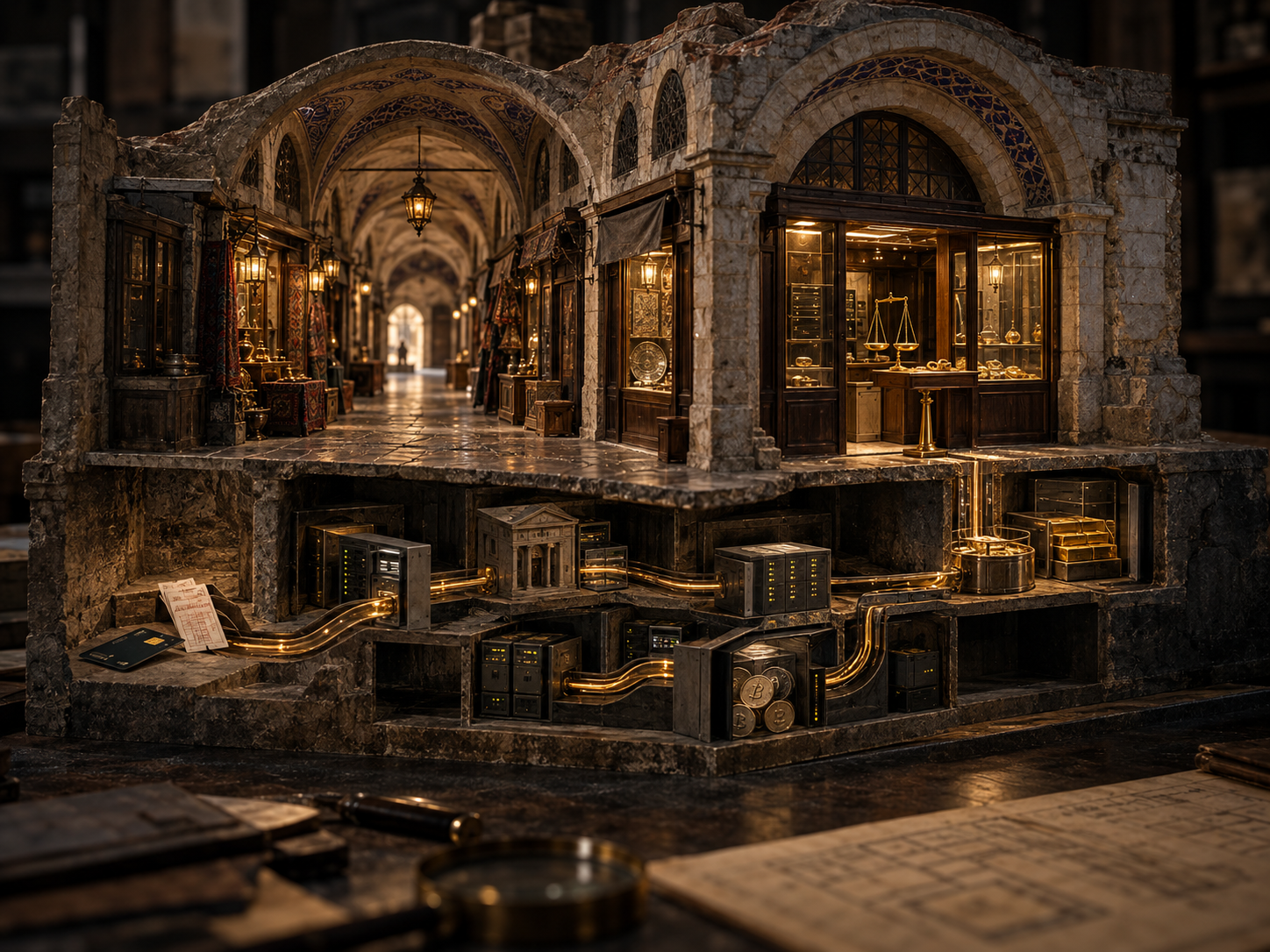
Tourists know the as a covered labyrinth of carpets and lamps that has traded since the fifteenth century. Istanbul’s money changers know it as something else: one of the country’s most important financial venues, where dozens of exchange offices and gold dealers trade cash, currency and bullion at a speed no bank can match, and where the street price of the dollar and of a gram of gold is set in real time.
That is why the bazaar sits at the centre of one of the largest money-laundering cases in modern Turkish history. Istanbul prosecutors’ investigation No. 2024/279446, known simply as the after the bazaar’s Turkish name, alleges that proceeds of illegal betting, forex investment fraud and cyber fraud were pushed into the banking system through shell companies and personal accounts, run through exchange offices in the bazaar, e-money firms and crypto platforms, and moved abroad. Prosecutors call it a “professional laundering system”.
The case has unfolded in waves. In November 2025, in what prosecutors described as the fourth, police detained 76 people in ten provinces, among them executives of the companies Hotto Yazılım and Coinvest Liz Bilişim. Another 68 were detained across 15 provinces in January 2026. Cars, flats and commercial property were seized.
In July 2026 prosecutors filed their indictment. According to Anadolu, it names 504 defendants: 36 at large and 134 in custody. Around 40 billion lira is alleged to have passed through the network. At its core, prosecutors place an organisation they link to forex fraud, allegedly led by Türker Ak, who is at large, and managed by Murat Dönmezoğlu, who is in custody. Prosecutors are seeking up to 34.5 years for Ak and up to 31 years for Dönmezoğlu. Betting money, in the prosecution’s account, flowed through the same channels, but the heart of the case is forex fraud rather than gambling.
One detail from the indictment stands out. The defendants allegedly tracked the flows in their own digital ledger, a system called . This was not cash in a back room. It was bookkeeping: who paid in, who was paid out, what commission was kept.
Another detail shows how long the bazaar was given the benefit of the doubt. Prosecutors had earlier decided not to pursue Faik Özbey, deputy chairman of the ’s owners’ board, or staff of the exchange office Venüs Döviz. After a report, that decision was reversed.
Other cases show the same machinery on a smaller scale. In June 2026 police detained 86 people in 24 provinces in a and betting investigation. Prosecutors allege the network worked with the owners of Kayalar Döviz, an exchange and jewellery business in the bazaar. regularly received deposits of about 100,000 lira and served as collection “pools” for bets. Turkish media put total turnover in the case at around 192 billion lira.
The bazaar is not the only place in Türkiye where this happens. It is the most symbolic. It is where betting money meets gold: an asset that leaves no digital trail, crosses borders easily and has served for generations as currency for people the banks will not serve.
The vault is a wallet
has been a household name in Türkiye for almost a decade. In 2017 police moved against his network in an operation codenamed Handikap. Prosecutors alleged he ran it with a British national, Scott William Masterton, and that it controlled about €5 billion across several countries. Şahin was in at the time and slipped away to Lebanon before Turkish Cypriot police could detain him. He was eventually arrested when he flew a private jet to his home province of Sivas to take his injured father to hospital.
He served his sentence and was released on 14 April 2023. According to Turkish Minute, he then left the country while his case was on appeal. By then his name had become political: in 2023 the opposition leader at the time, Kemal Kılıçdaroğlu, publicly asked the justice minister about two contradictory court rulings on Şahin issued on the same day.
On 30 January 2026, Istanbul prosecutors announced they had seized everything they could find: property, company shares, bank and investment accounts, and holdings on crypto exchanges. They allege he ran illegal betting platforms and supplied their infrastructure. The largest single item was crypto worth about €460 million, around $544 million, frozen by what prosecutors called “an international company”. later reported it was , the issuer of the stablecoin; chief executive Paolo Ardoino told the agency the company had reviewed information from law enforcement and acted in line with local law. Prosecutors say they have begun extradition proceedings with an unnamed country.
In the same investigation, according to Turkish media reports citing prosecutors, authorities also seized the assets of Şeref Yazıcı, owner of the UAE-based crypto platform Darkex, whom investigators link to Şahin. Those reports put the crypto frozen on his accounts at about $500 million and say Yazıcı is in the United Arab Emirates. That evening, as the journalist Bahadır Özgür pointed out, Darkex adverts were running on the electronic boards at a Kocaelispor–Fenerbahçe match.
The Şahin case captures a shift Turkish investigators and analysts have been describing for years. The safe in the basement has become a set of wallets that can be opened from anywhere. But the shift cuts both ways. is a centralised asset, and its issuer can freeze it when it chooses to cooperate. For a kingpin abroad, that is a vulnerability that did not exist when the money was in cash.
The state is also moving on the rules. In June 2025, required licensed crypto platforms to hold funds for at least 48 hours between a purchase or deposit and a withdrawal, and 72 hours before a customer’s first withdrawal. Some exchanges adapt; others end up in criminal files. In November 2025 a court appointed as trustee of the exchange Coino in a laundering investigation.
What the referees revealed
If anyone in Türkiye still doubted the reach of betting, the autumn of 2025 settled it. The (TFF) checked 571 referees working in the professional leagues and announced that 371 held accounts with betting companies and 152 had actively placed bets. One referee, the federation said, had placed more than 18,000 bets. TFF president İbrahim Hacıosmanoğlu promised that anyone who had stained the profession would never work in Turkish football again.
The scandal widened in rings. On 28 October 2025 the federation referred 152 referees to its disciplinary board, PFDK; 149 referees were suspended for eight to twelve months. On 10 November it referred 1,024 professional players, from Süper Lig regulars to third-tier squad members. Arrests followed in November and December, including Fenerbahçe and national-team midfielder Mert Hakan Yandaş and Galatasaray defender Metehan Baltacı. In July 2026, according to the Associated Press, 17 club officials were detained in Istanbul and nine other provinces. On 30 September the federation referred 448 people who had held executive posts at clubs in the top two divisions.
None of the players named has been convicted. Baltacı’s trial opened in March 2026; according to Anadolu, he has admitted betting as a youth-team player but denies doing so after joining the first team. The referees said in a joint statement that none of them had ever bet on a match they officiated.
The most revealing detail is not a name. The federation’s audit and the criminal cases that followed relied largely on data from legal, state-licensed betting platforms. The state could see exactly which referees and players had bet through its own system. On the illegal market, which by the justice minister’s own estimate handles most of the country’s online betting, it has no comparable view.
Başak, the former official, argues that the legal market works as an “incubator”. People learn to bet where it carries no stigma and no legal risk, then drift to illegal sites for better odds and bigger payouts. Halving the tax on legal betting in 2024, he told Medyascope, did nothing to shrink the black market.
At the end of September 2026 police detained Ferhat Gündoğdu, head of the federation’s central referees’ board, along with six others. Coming on top of the betting scandal, it was easy to read as the next chapter. It is not. The allegations in that case are mobbing, forgery and the unlawful recording of personal data. Gündoğdu was remanded in custody and resigned; his lawyers say he is innocent. Turkish football is living through several crises at once, and not all of them are about betting money.
Offshore, next door
The site a punter in Ankara uses is almost never in Türkiye. The harder the state squeezes at home, the more the question becomes where the operators are. Turkish officials point to a handful of places. Gürlek has named , Montenegro and Georgia in public comments.
. The breakaway north of the island, recognised only by Ankara, became a gambling hub after Türkiye banned casinos in the late 1990s. The US State Department’s 2025 narcotics control report says the north lacks adequate legal and institutional safeguards against money laundering. According to Cypriot press reports, the north’s parliament passed amendments in 2025 lifting the cap on casino licences and allowing casinos closer to schools; one opposition MP warned the territory would become an open-air casino. The violence has travelled too. In February 2022 Halil Falyalı, a former casino security guard whom Turkish reporters describe as a betting baron, was shot dead in the north. On 1 May 2025, Cemal Önal, described in the press as his money man, was killed in the Netherlands.
. According to an indictment summarised by Anadolu, Derkan Başer, a defendant from the old Handikap case, ran betting and online casino sites from the Georgian Black Sea city. Turkish media report he has lived in Georgia since 2018. Georgia also hands fugitives back: in one round of extraditions to Türkiye, 50 of 61 people returned came from Georgia.
Europe. A cross-border investigation by , FRONTSTORY.PL and NGL.media traced the business of Fedlan Kılıçaslan, the figure behind the MadridBet and MeritKing brands. His Warsaw-based company promoted betting sites without a Polish licence, a call centre linked to him was investigated by Ukraine’s SBU, and in November 2025 Istanbul prosecutors issued a warrant for his arrest. Türkiye blocked more than a hundred mirror sites for those two brands between 2018 and 2023; the number in MadridBet’s domain climbed from 10 to 569.
Armenia. The most surprising data point comes from Ankara’s own statistics. The state lottery administration publishes where the illegal sites it has blocked are hosted. In 2023, about 41,600 of 168,000 such sites, a quarter of the total, were hosted in Armenia. In 2024 Armenia’s share was 17%, second only to the United States at 56% and well ahead of the Netherlands at 6%.
Hosting is not ownership. The figures do not show that Armenian companies run these sites, and no public Turkish case we have found names an Armenian firm. What they do show is that Armenia has become the largest non-American infrastructure node for a market Türkiye is trying to strangle.
ShadowMonitor has reported on how Armenia became one of Eurasia’s biggest centres of gambling technology in “The Other Armenia”. Whether that industry connects to Türkiye’s illegal market is a question we are still working on.
Who gets cleaned
The campaign has results to show. Thousands of frozen accounts, hundreds of people in custody, licences revoked, crypto frozen at prosecutors’ request. Few governments in the region have gone after the payment plumbing of an illegal betting market this systematically.
There is another side to it that gets less attention inside Türkiye. The state’s main tool is , the deposit insurance fund that takes over seized companies as trustee. Over 2025 and 2026 it has absorbed far more than payment firms and crypto exchanges. As bne IntelliNews has tracked, the wave of seizures has run along three tracks at once: the case against Istanbul’s opposition mayor Ekrem İmamoğlu, the illegal betting investigations, and cases against alleged followers of the Gülen movement. The betting track alone has swept up television channels; one of them, Flash TV, was later reported sold to a construction company. , which prosecutors treated as a main artery for betting money, is now owned by a state bank.
None of this means the allegations against these companies are false. It means that in Türkiye the line between cleaning up the financial system and redistributing property is hard to see from outside. Courts have yet to rule in most of the cases described in this article.
Meanwhile the money keeps looking for new routes. Blocked sites return under new domains. are replaced. When one fintech closes, another takes its place. Başak, the former official, puts it bluntly: policing alone will not beat the market until someone asks why so many people, especially young people, want to bet in the first place.
One last thing. The , where prosecutors say betting and fraud money was turned into currency and gold, is not the only place in Türkiye where digital money becomes cash and bullion. On 4 September 2026 the US Treasury sanctioned , a small Istanbul investment bank. Washington alleges it was set up so that ’s oil revenue from China could reach Türkiye and be converted there into cash and gold by money exchangers. The bank rejects the allegations and says it will challenge them.
Türkiye is at war with one shadow economy. Another appears to be moving through the same country. That is the subject of the next part of this investigation.
If you have worked at a Turkish payment company, an exchange office or a betting operation and are willing to talk, contact ShadowMonitor through Secure tip.
A $3 billion Singapore laundering case. A Telegram marketplace bigger than Silk Road and AlphaBay combined. A casino empire extradited to China. This is where the money goes after the bet lands — and why the system moving it has learned to survive anything.
Read Investigation