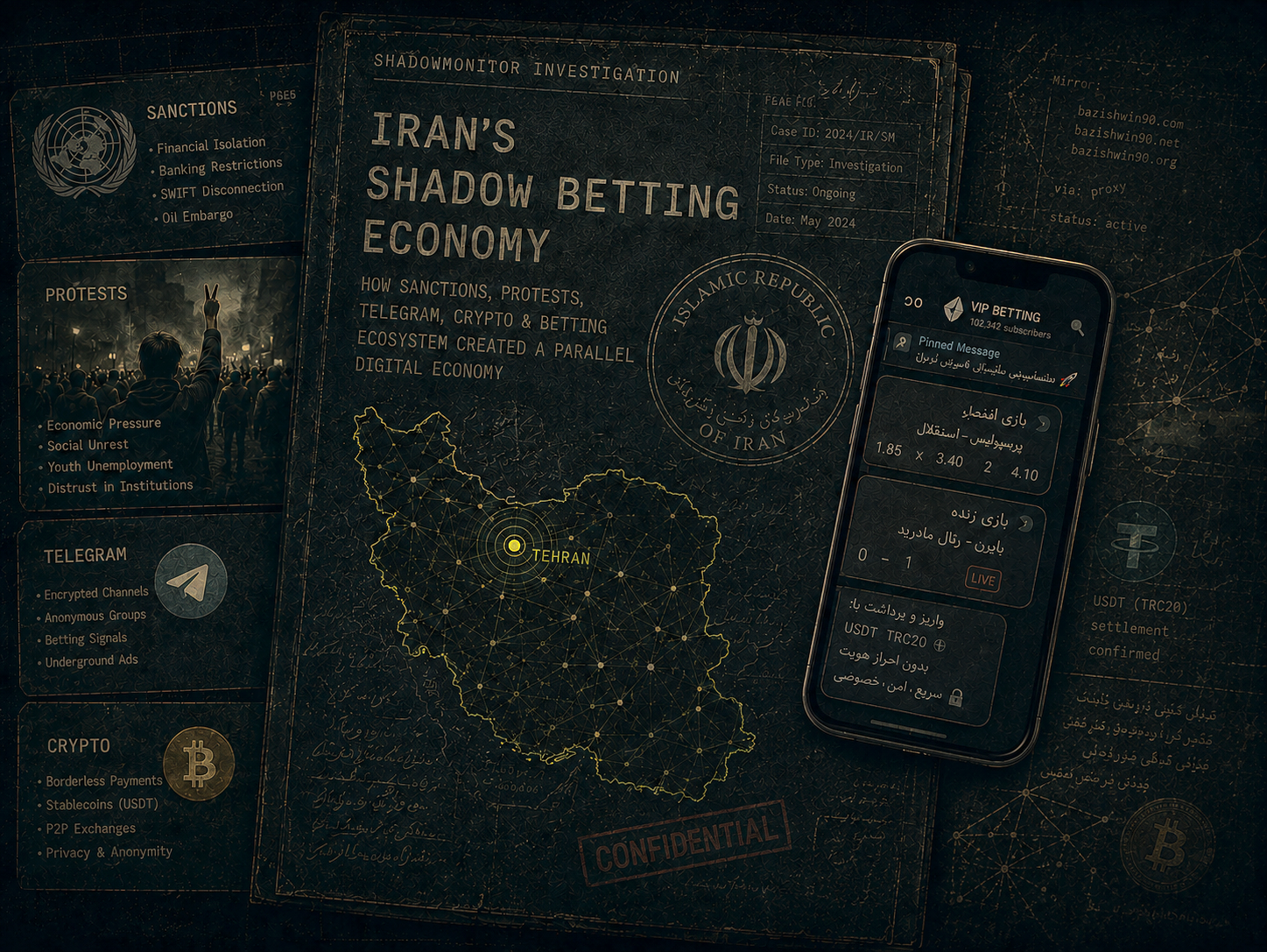
The Message
In the spring of 2026, while was dealing with a currency crisis, the largest protests since the Islamic Revolution and a direct military escalation with Israel and the United States, a popular Persian-language betting channel on Telegram posted a short message for its subscribers: "If the site is blocked, use a VPN through the UAE, Turkey, India or Canada."
Below it was a fresh address. Under that, a Telegram bot. And beneath that, instructions for topping up with on . At first glance it looked like a routine message from a grey-market betting operator. But in those details you can already see the architecture of a much larger system: as a coordination layer, as access control, as daily habit, and as the financial backbone.
What began as an underground betting market gradually became something bigger: a parallel digital economy able to function under sanctions, internet controls, banking isolation and war pressure. Betting platforms were one of its earliest and most visible layers, but they were never the whole story.
Before the Pressure Became the System
Online gambling has long been formally prohibited in , but by the end of the 2010s Persian-language sportsbooks and casino platforms had already become part of the local digital fabric. Football betting, live casino and especially — fast, multiplier-based products that travel well through Telegram virality — spread through Instagram, Telegram, affiliate networks and influencer marketing.
From the start, the ecosystem was built for a hostile environment. Domains rotated constantly. Telegram became the main access point. VPNs stopped being a technical trick and turned into a normal part of user behavior. One betting channel would pin a mirror, an APK, a VPN guide and a Telegram bot in the same message. Others published country-specific VPN whitelists for the UAE, Turkey, Hong Kong, India and Singapore.
A shared operational language emerged: "بدون فیلتر" for no filter, "آدرس جدید" for new address, "فیلتر شکن" for VPN and circumvention. These were no longer random SEO phrases. They became the grammar of the system itself.
New Financial Rails
At the same time, ’s financial environment was changing. Years of sanctions, banking restrictions and the chronic collapse of the rial pushed more and more economic activity toward OTC settlement, cryptoassets, informal remittance systems and other alternative payment rails.
That is where the betting infrastructure turned out to be unusually well adapted. By 2024 and 2025, on had become the dominant settlement tool inside the Persian-facing betting ecosystem. Operators were no longer merely "accepting crypto"; they were architecturally built around . Separate dollar and tether accounts, bonuses, cashback for crypto users, KYC-free onboarding, manual support over Telegram and automated payouts all became normal product features.
This is why the ecosystem quickly expanded beyond gambling. The same mechanisms — , , , , and — started servicing informal transfers, , , shadow commerce and other forms of sanctions-era survival.
Telegram as a Nervous System
The real backbone of the ecosystem was not the sportsbook and not the crypto exchange. It was Telegram. acted simultaneously as routing infrastructure, customer support, affiliate funnels, crypto onboarding layers, retention systems and anti-censorship coordination points.
During the protest waves of 2025 and 2026, when internet restrictions intensified, this infrastructure did not disappear. It adapted. Operators published new mirror addresses, tested VPN whitelists, moved users between channels and bots, created fallback routes and distributed APKs as a way to bypass browser-based access altogether.
That same bypass infrastructure was not limited to betting. Telegram routing, VPN use and crypto settlement increasingly became part of a broader social adaptation: protest communication, informal transfers, shadow imports and everyday workarounds for financial restrictions. What had once been a marginal technique became a mass habit.
Dubai, Turkey and Armenia
Although the audience of the ecosystem sits inside , the infrastructure around it is deeply regional. functions as a , a crypto-conversion center and a relatively safe operational zone. It is where infrastructure operators such as can connect Persian-facing betting brands, Telegram acquisition campaigns, / payment systems, crash-game ecosystems and KYC-free onboarding flows.
Turkey has long served as a relocation hub, an influencer base and an external operational layer for Persian-facing betting businesses. Many of the Instagram promoters who helped scale these brands worked from Turkey, where they could operate at a distance from ian enforcement. One of the most visible cases is , whose luxury-lifestyle gambling promotion built a mass audience before his extradition to and later death sentence. His disappearance did not stop the infrastructure from moving on.
Armenia is the quietest and perhaps the most interesting regional adapter. Through and , it has become one of the region’s major layers. That broader increasingly connects Persian-facing digital businesses with , technology providers and regional infrastructure. It makes Armenia not just a side note, but a future investigative node in its own right.
The State Question
The hardest question in the whole story is the role of the ian state. Officially, authorities prosecute gambling, block platforms, arrest influencers and periodically launch anti-gambling campaigns. Yet the crypto economy keeps growing, keeps expanding, keeps adapting and bypass mechanisms keep becoming more systematic.
The result is not a clean binary of state versus underground. It looks more like a hybrid system in which underground commerce, private initiative, sanctions adaptation and some state interests end up using the same operational rails. Under severe geopolitical pressure, the line between tolerated shadow economy and survival infrastructure becomes increasingly blurred.
That is why the story is not really about gambling at all. Gambling is only the visible layer that lets you see the machinery underneath.
The Parallel Digital Economy
To the outside world, is often described as isolated, technologically constrained and economically damaged. But below the surface, a highly adaptive has emerged — one able to function under sanctions, banking isolation, internet blocks, currency collapse, protests and war.
Individually, the components do not look extraordinary: , mirrors, VPNs, , , , referral codes, bots. What matters is how they are connected. Over time, betting platforms, crypto settlement, bypass culture, shadow remittances, OTC infrastructure and regional intermediary corridors began to share the same operational rails.
And that is what makes the story larger than gambling, larger than crypto and larger than Telegram. It is one of the most interesting parallel digital economies formed under long-term geopolitical pressure.
While European leaders discuss Armenia's future in Europe, a different Armenia quietly powers gambling infrastructure used across multiple continents — including parts of the ecosystem surrounding Iran's parallel digital economy.
Read Investigation