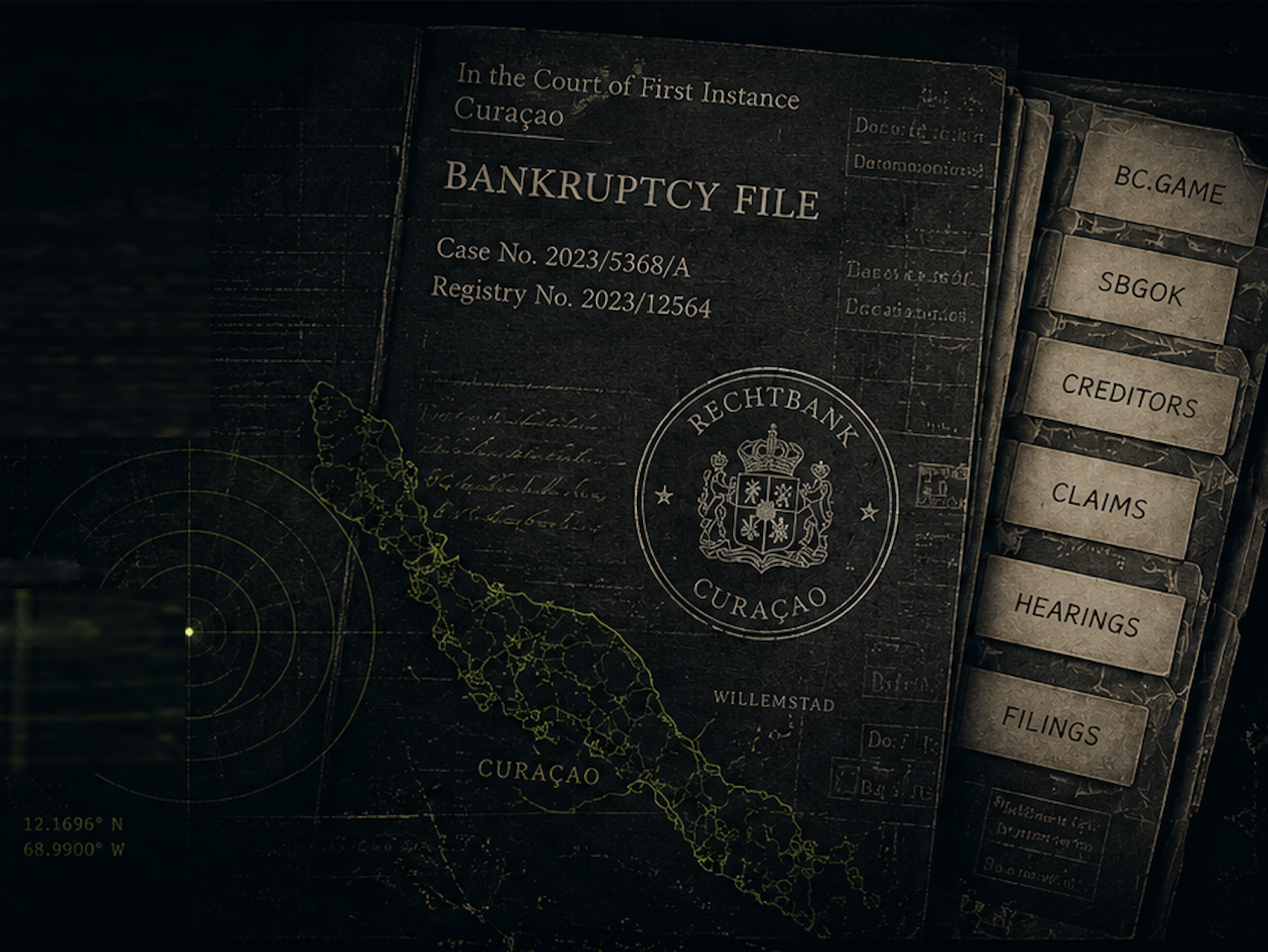
The bankruptcy decree being used to wind up crypto casinos in Curacao predates the online gambling industry by some seventy years.
The — literally the bankruptcy “decree”: not an act of any parliament, but an instrument of colonial administration that has kept the force of law to this day — was drafted for a Dutch colony, and still speaks its language. The text currently in force reads like a patchwork: articles in pre-war Dutch spelling sit beside later insertions in the modern orthography; jurisdiction is mapped onto “island territories,” administrative units abolished in 2010; and the statute addresses itself to the Netherlands Antilles — a country that vanished from the map sixteen years ago. The internet, cryptocurrency and cross-border wagers do not exist in this universe.
And yet this is the statute that has become the legal instrument of choice against Curacao-licensed operators — an instrument so indiscriminate that it catches companies that dodge their obligations and companies that merely dispute them with the same ease.
The reform that did happen — the , which came into force in December 2024 under a new regulator, the — dismantled the old master-licence system and demanded genuine local presence and stricter compliance. It pointedly left the bankruptcy decree untouched. To see why that matters, watch how the 1931 decree actually works.
A Decree That Never Asks Whether You Are Bankrupt
By modern standards, the is brutally simple. Article 1(1): a debtor “in the condition of having ceased to pay” shall be declared bankrupt on the petition of one or more creditors. Note what the decree asks. Not whether the debtor can pay — but whether it is paying. A factual cessation of payments stands in for the substantive insolvency test around which modern bankruptcy regimes are built, including the Dutch one in force on the far side of the Atlantic, nearly eight thousand kilometres away, yet inside the very same Kingdom.
The review is summary: it is enough that the claim and the cessation of payments “summarily appear” from the circumstances. An examination on the merits is not what bankruptcy proceedings are for — that belongs in ordinary civil litigation. The formal requirement of a plurality of creditors looks like a safeguard on paper; in practice, any large operator trails thousands of aggrieved players across the globe, and specialist lawyers rarely need more than a couple of phone calls to assemble the required minimum of co-petitioners. The threshold for setting the machine in motion can be a few hundred euros.
There is a second design flaw — less visible, but for industry lawyers arguably the bigger one. As a rule, a foreign judgment has no automatic force in Curacao: the code of civil procedure requires recognition and enforcement proceedings — — in which a court checks whether the foreign court had jurisdiction, whether due process was observed, and whether recognition would offend public policy. A bankruptcy petition skips that filter entirely. An Austrian or German judgment — frequently a default judgment, entered without the operator ever appearing — is placed directly at the foundation of a bankruptcy filing, and none of the questions exists to answer ever gets asked. The foreign judgment acquires coercive effect without ever passing the recognition test.
From there, events unfold not as a list but as a chain reaction. The bank that serviced the company yesterday freezes its accounts today — nobody wants a bankrupt counterparty. The payment provider switches off deposits. The software partner suspends the contract rather than become the next name on a claim form. The company’s signature loses legal effect. And even if an appeal overturns the ruling months later, most of that chain has already run its course. Crucially, the reaction is triggered not by the judgment but by the petition itself: for the weeks between filing and verdict, the operator’s counterparties are reading the news, not the case file.
Who Steps in the Trap
DAMA N.V.
ARAXIO DEVELOPMENT N.V.
BC.GAME
Read these cases not one by one but as a series, and a pattern emerges. The mechanism engages with equal ease against a company that disputes a debt rather than refusing to pay (); against one that quietly emptied itself of assets beforehand (); and against one trying to wall off its liabilities behind fresh corporate wrapping (). What unites them is not innocence or guilt — it is that the point of entry is the fact of an unpaid claim, however contested, rather than any assessment of the ability to pay.
Which is why the results read like a lottery in which every party takes a turn losing. in 2024 paid, under the pressure of the procedure, claims it was still contesting. ’s players won every court and collected nothing. ’s petitioners secured a bankruptcy on appeal — and more than a year later are watching the defendant litigate on under an licence. And the petitioners against in 2026 walked away holding the bill for costs.
The Claims Industry — and Its Civil War
The system is not standing still. On the claimants’ side an industry has grown up: Germany’s buys and funds player claims; the Curacao-based foundation aggregates the aggrieved (its efforts bankrupted 1xCorp in 2023 and in December 2024); and the petitions are carried into court by the same small circle of local lawyers — the petitioners against in 2026 were represented by attorney , who had brought a bankruptcy petition against Stake.com two years earlier.
That machine should not be mistaken for a monolith. According to Vixio GamblingCompliance (July 2026), the claimants’ camp has descended into internecine war: the foundation’s founder, journalist , was suspended from her role after court proceedings in October 2025; the foundation’s website has carried a “temporary interruption” notice since September 2025; and in March 2026 a German national sued for €8.4m over ownership of a player-recovery platform (the case is pending). Tellingly, none of this slowed the pressure: the February petition against was filed directly on behalf of three players — by again. The machine didn’t stop; it mutated. And the bar keeps dropping: where petitions once rested on foreign judgments at least, a demand letter will now do.
On the other side of the trench, the courts are drifting the opposite way. Twice in the past year and a half the Court of First Instance has thrown out bankruptcy petitions against operators — in October 2024, in February 2026 — repeating the same formula: bankruptcy proceedings are no substitute for litigation on the merits. The judges are, in effect, hand-patching the statute’s archaism. But hand-patching has limits: the appeal showed that a first-instance dismissal guarantees nothing, and operators are escalating in their own way, demanding security for costs from petitioners to raise the price of admission.
And there is a third answer, the simplest of all: the door. left for . (Lalabet, JungliWin) took the same route in the opposite hemisphere: before its own bankruptcy it dissolved itself in Curacao and moved its brands to a Costa Rican company. The door out of a grey jurisdiction, though, does not lead towards the light — issues licences in the name of an “autonomous island” of the Comoros, an activity the Comoros’ own central bank has repeatedly branded fraudulent and illegal. The routes are mapped; the precedents set. For now these are isolated departures — but every new case is a public stress test, and each one has every operator re-running the calculation of whether a Curacao licence is worth the exposure.
The Reform That Fortified the Front Door and Forgot the Back
The moment for a fix could hardly have been better. In December 2024 the came into force: the most sweeping overhaul of Curacao gambling regulation in decades. Licensing passed to the state regulator, the ; the price of entry rose along with the standards. By April 2026, according to industry data, the — which replaced the former Gaming Control Board in July 2025 — had processed some 140 direct-licence applications, approving 87 and rejecting or deferring the rest: a refusal rate of roughly 38 per cent.
More than that: the tried to build a civilised route for player disputes. It requires operator-player agreements to select Curacao law and the Curacao courts, and a licence issues only if the operator signs up to a regulator-approved mechanism. The design intent is transparent: disputes should be resolved on the merits inside the Curacao legal order before any coercion is applied. By July 2026 the regulator lists eleven certified providers, the procedure is free for players, and one provider alone has taken several hundred complaints — though typical amounts run to hundreds of euros, not hundreds of thousands.
The 1931 back door, meanwhile, stands wide open. The reform did not touch the decree at all — and the practice keeps nullifying the legislature’s design: why would a player bother with Curacao when a default judgment, or now a mere demand letter, can be converted into a bankruptcy petition that bypasses both and any hearing on the merits? is not even a mandatory pre-litigation stage. And the February 2026 petition targeted an operator of the new model: holds a direct licence, with all the local-substance costs that entails. The new licence protects against the old complaints. Against the , it protects against nothing.
Why it turned out this way is political, not legal. The is a product of pressure from The Hague, not an initiative of Willemstad. Formally, since 10 October 2010 Curacao has been a constituent country of the Kingdom of the Netherlands — an equal partner, in a relationship where the word “metropole” should long ago have been retired. In practice, the former metropole still talks to its former colony in the language of tranches and conditions: after the pandemic-era financial tranches of 2020, the terms were codified in the agreement, and one line item was a clean-up of the gambling industry. Later came the risk of the grey list — a stain that would spread to the Kingdom as a whole.
Subtract one motive from the other and an uncomfortable symmetry emerges. The reform was written by other hands and to other priorities: it cleaned up precisely what cast a shadow over the Kingdom’s shopfront, and left exactly as it was precisely what strikes the island rather than the metropole. Harm to Curacao was never in the brief — and you can see it not in the words but in what survived. What was left unfinished, at the very edge of The Hague’s interests, turns out to be the concern of Curacao alone — the party with the fewest levers, in this whole story, to change anything.
When Nobody Was Counting
Ships are flagged in Liberia, forex brokers in Belize, online casinos in Curacao. From the line flows an easy inference: the little Caribbean island lives off gambling. It is a fine thesis — and one that nobody can verify, the government included.
By one 2026 estimate, direct budget receipts from online-gambling licensing run to about 40 million guilders a year, roughly €20–25m. Set against total government revenue for 2024 — just under 1.96 billion guilders — that is a little over two per cent. This from an industry that churns billions of dollars in wagers through Curacao-licensed brands every year. A tax on gaming turnover? There isn’t one. A profit tax formally exists, but is built so that the final figure is effectively left to the operator’s discretion.
The Tax You Choose Yourself
The real diagnosis lies one level deeper. Even these modest receipts are beyond the state’s ability to track. The aside, it is the Board of Financial Supervision — the — that said it plainly, in a May 2026 letter to the finance minister: gambling operators’ fees are booked under “other income” with no breakdown, and the budget accounts make it impossible to establish what the industry actually contributes. The fast-growing sector for which the entire licensing framework was rebuilt appears in the state’s own accounts under “miscellaneous.”
And here is the easy mistake to make — the parliamentarian included. Everything above invites a reassuring conclusion: if there is effectively no direct tax, and the licence fees are a paltry two per cent, the island has little to lose and no reason to stir. That conclusion is exactly half right — which is what makes it dangerous. Yes, there is almost nothing to count on the direct side: it was zeroed out by design. But what follows is not “nothing to lose” — it is the opposite. If the direct receipts are a structural triviality, then whatever value the island actually holds must lie somewhere else. In the one place nobody has measured at all.
That “somewhere else” is the economy around the industry. The licence fees go to the budget; the real money stays on the island — in salaries, rent and contracts. Over three decades a whole stratum has grown up: lawyers and compliance officers, accountants and auditors, trust and corporate administrators, IT and hosting staff, payments-sector employees, the Willemstad office blocks that lease them space. These are Curacao jobs, Curacao rent and Curacao tax on those salaries and firms — and this, unlike the licence fees, nobody has counted at all. It is here, not in the two per cent, that the real stake may lie: a layer that pays income tax, rents offices and feeds an adjacent service economy can be worth several times the licence-fee line — and it is the first thing that evaporates when operators leave. The has only thickened that stratum, binding to the island precisely the part of the industry the decree drives away. What it is all worth, no public estimate exists — because the question, as far as anyone can tell, has never seriously been asked. The island is risking something it has never measured.
Deciding Not to Decide
It would be tempting to conclude that the island and The Hague deliberately wrote the industry off. But that presumes knowledge nobody possesses. To write an industry off, you first have to value it. To defend it, likewise. Neither has been done: the direct revenue is buried in “other,” and the indirect economy has never been counted by anyone at all.
So the honest diagnosis is smaller than any theory of intent. The government of Curacao did not choose to sacrifice the industry; it simply never made a decision, because it never saw that a decision was required. The operators bruised by the carry no political weight on the island. They do have a trade body of sorts — the Curacao Online Gaming Association, set up in 2022 to “give the industry a voice” — but on the bankruptcy decree that voice is nowhere to be heard, not in the court cases, not in the reform, which The Hague wrote. These are mostly non-resident companies, with no one on the island to take up their cause in earnest.
Which is precisely why it does not move. The fix, for all the weight of its consequences, is technically trivial: a modern insolvency regime with a substantive test and an requirement for foreign judgments has worked in the Netherlands for generations, and Curacao’s own judges are already, ruling by ruling, hand-building what the legislature never wrote. Note how the answers a direct question about it: the problem is known and “being addressed,” but reform is not the regulator’s remit — it belongs to government in the broader sense, and the specifics would be premature to discuss publicly. In other words, the task has been acknowledged and left on the table — ownerless, with no deadline and no one accountable.
And that stake is not the operators’ alone — which may be the central misreading of the whole affair. The works properly for no one. Operators pay disputed claims under duress, or decamp to worse jurisdictions. The players the mechanism is nominally there to protect win their cases and collect nothing: when the assets have been moved out in advance, the bankruptcy guts an empty shell while the money sits elsewhere. The claim funds that bundle those claims litigate for years to unpredictable and often zero effect. And the island on whose soil all this unfolds cannot even estimate what it is losing. The one thing the law produces efficiently is uncertainty, shared out evenly among every party.
The reform was meant to give the island control of its gambling sector. Almost two years on, the licence fees move as crypto through Prague, the supervisory systems were built and are run by a private Maltese firm, and operators can still be forced into bankruptcy under a colonial 1931 law the reform never touched — and almost none of it is under the island's control.
Read Investigation