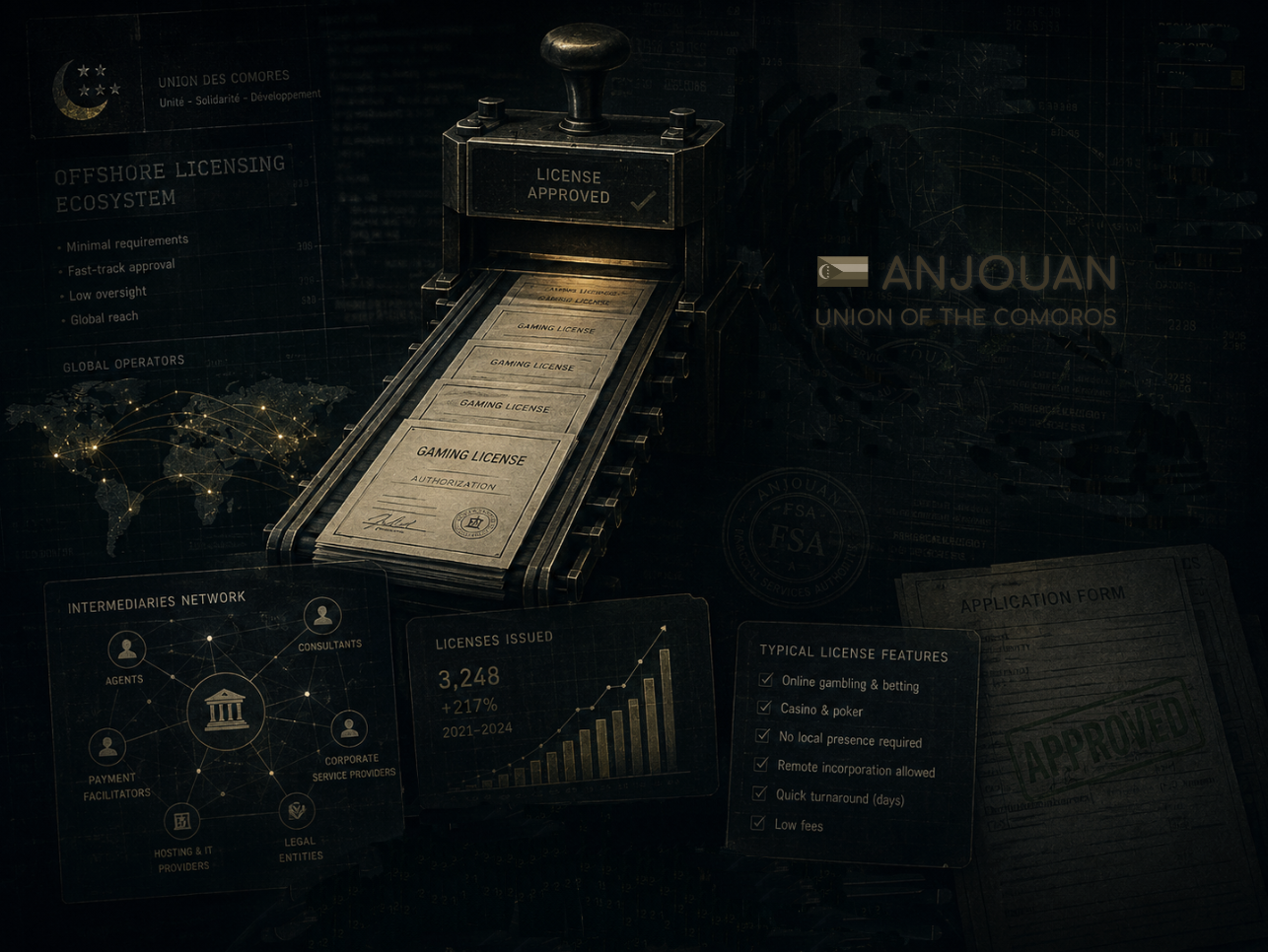
In Telegram groups dedicated to gambling startups, is usually mentioned with almost no ceremony.
A place where licensing is fast, onboarding is remote, and the paperwork feels designed for speed.
It is spoken about the way operators talk about logistics: as a service layer, as a default expectation, a jurisdiction packaged for short timelines and distributed teams.
What almost nobody in those chats mentions is what the government of the country belongs to thinks about all this.
is one of the three islands of the Union of the Comoros, a small state in the Indian Ocean between Mozambique and Madagascar.
The licensing operation marketed as claims authority under the constitution of the “Autonomous Island of ” and a pair of local acts from 2005 — the Betting and Gaming Act and the Computer Gaming Licensing Act.
The federal authorities of the Comoros see it differently.
The — the country’s sole financial regulator — has repeatedly described the island’s offshore licensing bodies as fictitious structures that issue licenses illegally.
It has stated flatly that has no laws of its own. Only the laws of the Union of the Comoros are recognized.
And the story of how that dispute came about is the story of how a failed secession became a business model.
Born From a Secession
The licensing machine was not designed. It was left behind.
In 1997, declared independence from the Comoros after years of political turmoil — the country has survived roughly twenty coup attempts since independence from France in 1975.
No state recognized the breakaway island.
But its separatist administration needed revenue, and it found one of the oldest revenue sources available to unrecognized territories: selling regulatory paper.
Among the parallel institutions the separatists created was the — the Offshore Finance Authority.
Under a 1999 banking regulation, the island began licensing offshore banks by mail order. Together with the neighboring island of Mohéli, which ran a similar scheme, handed out more than a hundred banking licenses.
Applicants did not have to appear in person. A faxed passport copy and a police certificate were enough.
A US State Department assessment from that era concluded that neither island had the expertise or resources to regulate an offshore sector at all.
The consequences arrived quickly.
By the mid-2000s, the International Chamber of Commerce’s financial crime bureau was warning that multiple people on claimed authority to issue bank licenses — and that none of them were credible.
Its investigators described one -registered bank with no physical location and a fake Irish address that had nonetheless managed to get itself listed in a major business directory.
Another, despite having its license revoked in 2003, kept issuing documents and was negotiating with two North Korean banks to set up a new offshore institution.
The political side of the story ended in 2008, when the Comorian army, backed by the African Union, invaded and removed the island’s strongman, Mohamed Bacar.
The island was reintegrated. Its autonomy, enshrined in the 2001 constitution, was progressively curtailed.
Banking laws passed in 2013 and 2015 stripped of any regulatory status.
Legally, the authority ceased to exist.
Commercially, it never went away.
The Government Says No. Loudly. Repeatedly.
The has not been ambiguous.
In 2022, it issued a public warning describing as a fictitious structure issuing licenses and offering banking and financial services illegally through websites and online platforms.
In 2023, it repeated the point, extending it to the firms selling those licenses.
In earlier statements it had already asserted that no offshore financial license had ever been lawfully granted by any of the Comorian islands, included.
In one of those warnings, the bank accused the island’s phantom regulators of a simple business model: “They operate online via websites to scam people.”
The most direct formulation came in 2026, when the secretary general of the central bank’s financial intelligence unit, , responded to press inquiries about an -licensed betting site being promoted by influencers in Ireland.
His position, as reported by the Irish Times: the offshore authority is not recognized in the Union of the Comoros. The entity issues licenses illegally. Gambling itself is not authorized in the country. The central bank is the only body competent to license financial activity.
And the island of has no laws of its own.
International bodies have effectively corroborated the federal position. The 2024 mutual evaluation of the Comoros records that gambling is prohibited under the Comorian Penal Code — which is why the country’s gaming sector received no AML/CFT assessment at all.
At the national level, the licensed activity is not merely unregulated. It is criminalized.
Set that against the marketing. ’s public materials describe a supervisory board, license categories, compliance reporting deadlines and enforcement actions — the full vocabulary of a functioning regulator.
The dispute between that vocabulary and the federal government’s position is the entire story.
Who Is Actually Selling the Licenses
If has no legal existence, someone is still cashing the checks.
Reporting by Australia’s ABC in late 2025 — the investigation that triggered the current wave of scrutiny — traced the commercial layer behind the brand.
Businesses seeking an license are directed to a company called , presented as the authority’s sole authorized agent.
The firm lists no directors or board members on its website.
Comorian financial intelligence officials told the ABC that the company operates illegally.
SBC News has reported that the operation is led by British nationals — members of the Dvorkin and Sorsky families.
A second vehicle, , appeared in 2023 — precisely when demand exploded — and claims to issue gambling permits through an “ Control Board”.
By its own count it has issued more than 1,300 gambling licenses.
At a reported price of roughly €17,000 per year, that implies a revenue stream in excess of €22 million annually.
Its ownership is not publicly disclosed. Domain registration records reviewed by the ABC link it to , a Costa Rica-based consultancy run by Canadian , who has long promoted in industry publications as a cheap, fast route to market.
and did not respond to the ABC’s requests for comment.
Why the Machine Keeps Running Anyway
Here is the uncomfortable part: none of this has stopped the model.
If anything, the years of the loudest official warnings were also the years of fastest growth.
Part of the answer is the Curaçao exodus.
When Curaçao’s reform dismantled the master-license system in December 2024 and began demanding real substance, stricter AML controls and direct licensing under the — while the island’s colonial-era insolvency law was being used aggressively against solvent operators — a portion of the industry went looking for a softer wrapper.
was standing there with a two-week turnaround and no such baggage.
Industry observers have tracked a steady migration of former Curaçao licensees toward the island ever since.
Part of the answer is that the license, whatever its legal status at home, performs its real function abroad: it opens doors.
The ABC’s test of — an -licensed operator that Australian authorities had already identified as illegal in early 2025 — is instructive.
The site continued accepting Australian customers through local payment methods, cards and e-wallets alongside crypto.
When journalists began asking questions, two payment providers, including MiFinity, quietly disappeared from the site within hours.
The license had done its job for as long as nobody looked. Scrutiny, not regulation, was the only force that changed anything.
And part of the answer is that the license has crept upmarket.
In February 2026, Le Monde reported that a subsidiary linked to — France’s state-controlled national lottery operator and the parent of B2B supplier Relax Gaming — had obtained an license.
Meanwhile, betting brands waving paperwork are being promoted by mainstream sports influencers in Ireland and the UK.
What began as a wrapper for crypto casinos has become part of the toolkit of publicly listed European gambling groups.
The Product Is Deniability
The original way to describe was as a jurisdiction packaged for speed: as a service layer, bundled with , filled by , settled through .
That description is still accurate. But the Comoros conflict reveals what the product underneath actually is.
An license does not grant permission — the only state in a position to grant permission says the license is illegal.
What it grants is deniability, distributed across every participant in the chain.
The operator can point to a certificate.
The payment processor can point to the operator’s certificate.
The affiliate can point to the payment processor’s willingness to process.
The game supplier can point to industry practice.
Each layer needs the license to look real only to the next layer — and only until someone with subpoena power starts asking questions.
That is why the central bank’s warnings change so little.
The warnings attack the license’s legality. But the market never priced its legality — it priced its plausibility, and plausibility is manufactured by the ecosystem itself: verification seals, compliance-report deadlines, enforcement announcements, glossy conference booths.
The regulator can be fictitious as long as the paperwork is not.
therefore matters less as a jurisdiction than as a proof of concept — and a more radical one than Curaçao ever was.
Curaçao showed that a small state could sell light-touch regulation.
shows that the state is optional: a licensing brand can outlive the government that created it, survive its own legal dissolution, and keep generating tens of millions a year — provided the surrounding infrastructure of payments, traffic and settlement is willing to treat the paper as real.
The question the industry should be asking is not whether the license is valid. The Comoros answered that.
The question is how much of the global gray market is running on paper that only works because no one in the chain has an incentive to check.
That is the real offshore machine.
A colonial-era bankruptcy decree can strip Curacao of its online-casino operators — and no one fixes it, because no one has ever counted what the island would lose.
Read Investigation